This summer, Astana played host to an interdisciplinary art and science exhibition, one of the first attempts in Kazakhstan to bring eco-ethics into the realm of creative production, which asked how humans might learn to listen to the land again.
The exhibition, titled Field Notes Post-Terraformation, was the result of the Caspian Artist Residency initiated by the AMA Foundation in Atyrau, in the west of Kazakhstan.
Over several weeks, residents Dauren Kaliaskar (a biologist and artist from Kazakhstan), Laura Rodríguez (a bioartist and curator from Mexico), and Daria Testo (a Buryat-Mongolian curator and researcher) carried out fieldwork in the Atyrau region.
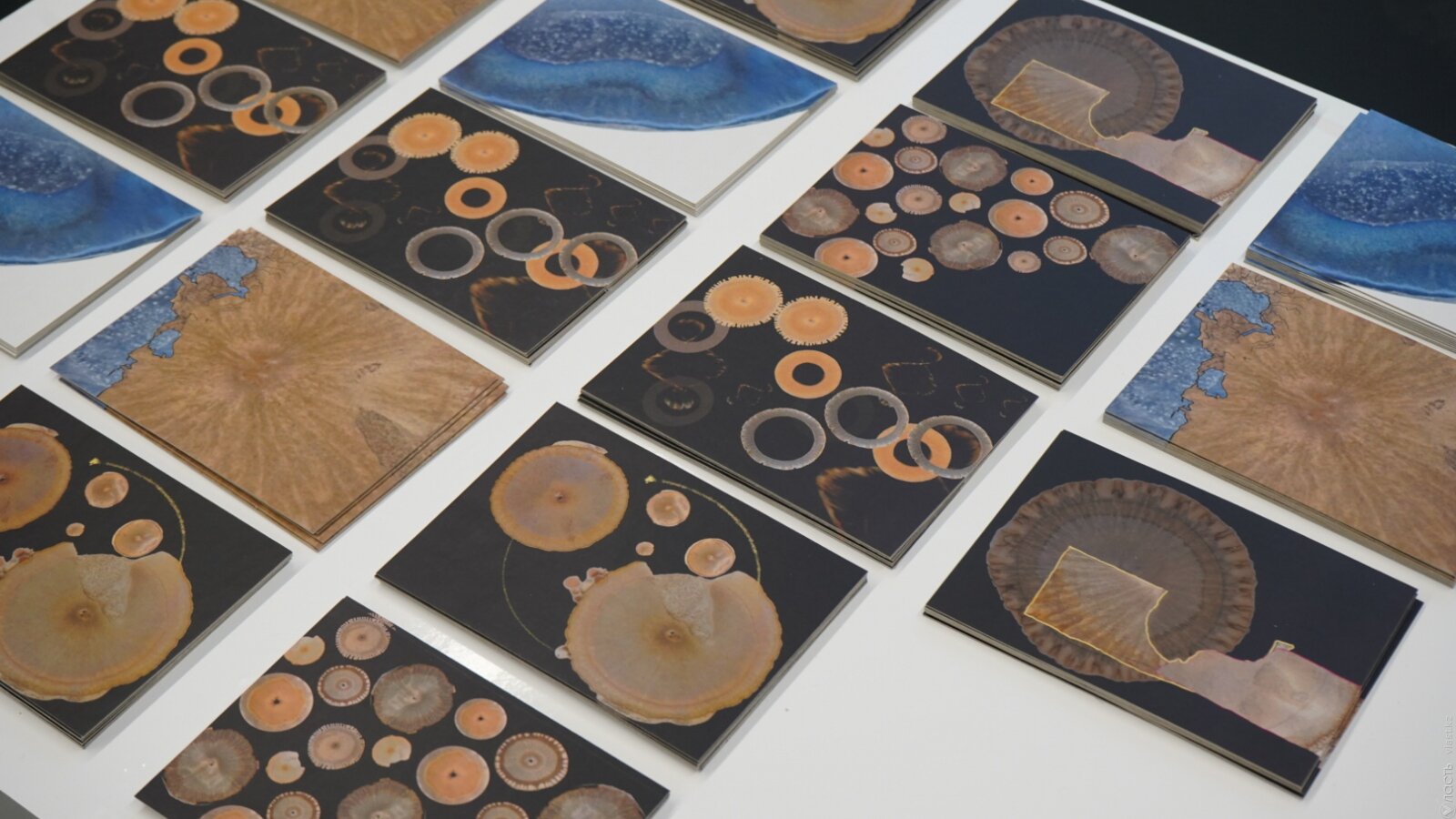
They studied sacred and industrial sites, recorded seismic vibrations through geophones, transformed them into 3D porcelain objects, and created soil chromatograms. These abstract watercolors became “portraits of the land.”
“We wanted to show that soil is an archive, a living organism, not just an industry background. We tried to capture its breath through sound,” explains Kaliaskar.

Atmosphere of Listening
The Astana exhibition was rather unconventional. Visitors entered a dimly lit room where an enlarged zine spread, surrounded by sepia-toned photographs and video projections, dominated the space. In one corner, figures in white, flowing suits, hovered directly above ground, causing teenagers in the audience to quietly wonder whether they were witnessing images of a futuristic expedition through space.

The artists later revealed that the suits were not designed for cosmic exploration but represented a symbolic boundary, a gesture of respect for the soil, an attempt not to impose human materiality on it — a principle formalized in the project’s Code of Conduct.
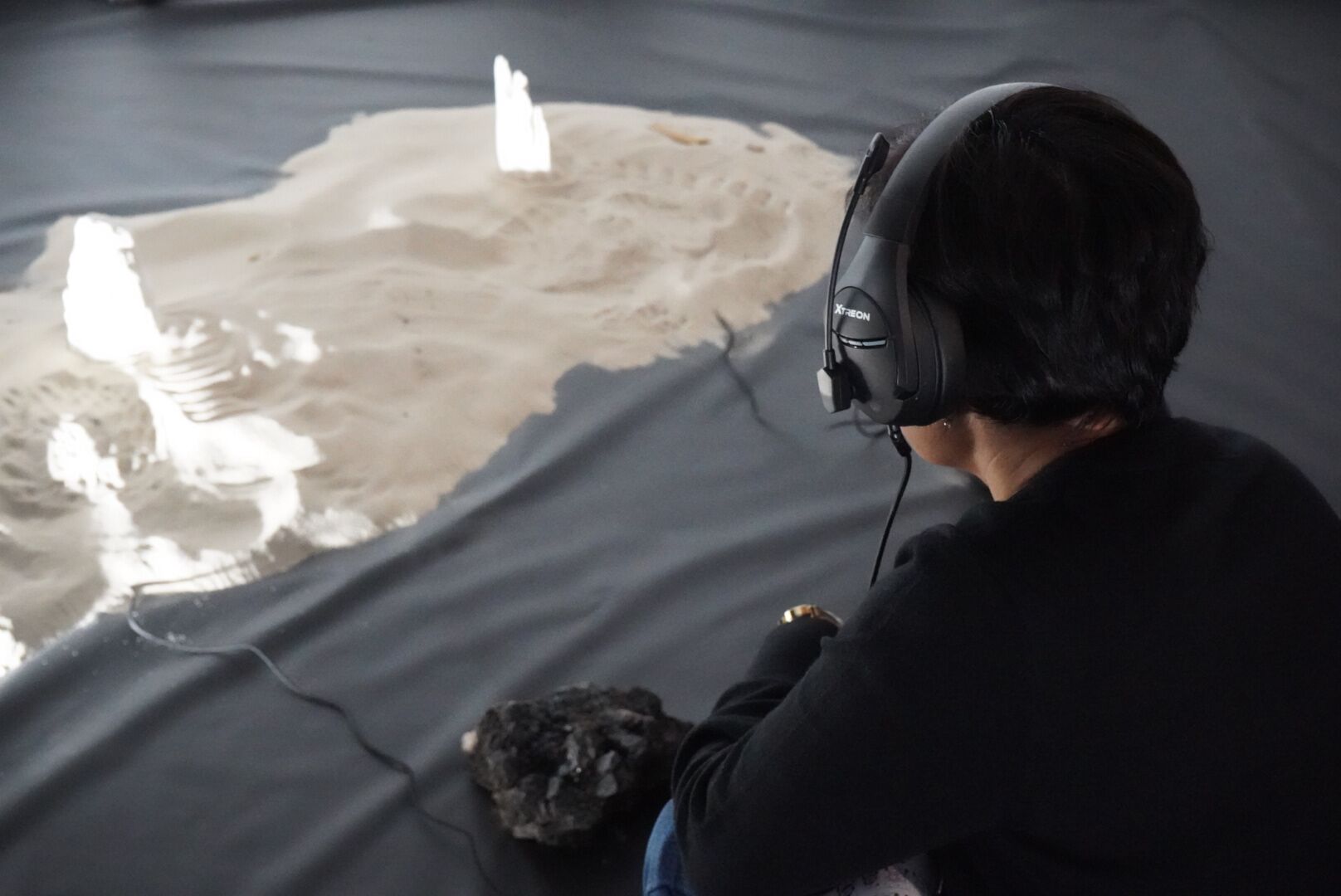
Sound was also a key part of the exhibition. Headphones placed on stones scattered across the floor allowed visitors to hear low, pulsating rhythms — the “breath” of the Earth itself.
As even the youngest guests fell silent, the experience served as a reminder that art and science can reveal unseen layers of reality and resonate across generations.

A New Code of Conduct
One of the project’s central outcomes was the creation of the Code of Conduct for More-Than-Human Interrelation. Part manifesto, part ethical guide, it proposes practices of care and reciprocity:
· Listening as a method, moving slowly, accepting refusal.
· Reciprocity, offering something back whenever you take or receive.
· Shared authorship, acknowledging contributions given by soil, plants, animals, and spirits.
· Postcolonial awareness, unlearning habits of extraction and domination.
· Documentation as witnessing rather than possession.
· Consent as a ceremony, from both humans and the land.
“When I work in research with humans, I’m always asked about consent and ethics. But when it comes to more-than-human narratives — soil, plants, animals — that’s rarely discussed. We wanted to bring eco-ethics to the center of this dialogue,” says Testo.
Rodríguez adds: “Walking barefoot made me more attentive, more sensitive. The earth felt closer, softer, alive even after putting my shoes back on. We need such practices to restore our relationship with the more-than-human.”

Beyond Objects
Ultimately, the project’s curators hope that the Code will set out a methodological approach extending far beyond the art installation on display.
“What matters most is the ethical framework of working with the living and non-living, the material and immaterial,” stresses curator Asel Akhmetzhanova.
Co-curator Asel Mukasheva agrees: “What excites me most is the zine. There are many conversations today about reinventing modernity, but very few concrete practices. This exhibition offers precisely that — practices of a new ecology of relations.”

Field Notes
Field Notes Post-Terraformation offered an interdisciplinary attempt to articulate a new ecological and ethical language, a rare addition to the more formal and straightjacketed cultural environment in Kazakhstan.
All soil samples collected during the residency were later transferred to the Botanical Garden of Astana, a gesture of care well within the project’s stated goals.
The residents’ work signals how art and science can become a space for rethinking the future, one where humans are no longer the only voice, but one among many. As Rodríguez notes in her field diary:
“How do we relate to soils, beings, and landscapes after hyper-terraforming, when land has been colonized, traditions erased, more-than-human forgotten?”
Upon leaving the exhibition, it is clear that there are no easy answers. The project is an invitation to listen again to the soil, to memory, to rhythms that connect us with what is larger than ourselves.
Field Notes Post-Terraformation is an interdisciplinary art and science project carried out through the AMA Foundation’s Caspian Artist Residency and presented within the Pro NRG Fest in partnership with Chevron.
Ainur Sagadat is the PR director at AMA Foundation.
Поддержите журналистику, которой доверяют.