Though little known outside the country, Kazakhstan’s “Polgyon” was one of the most important theaters of the Cold War, playing host to hundreds of nuclear tests over four decades of operation as the Soviet Union raced to build the world’s most powerful weapon.
Located about 120 kilometers from the north-eastern city of Semipalatinsk — now known as Semey — the Polygon saw its final nuclear test on 19 October 1989, following months of nationwide protests led by the grassroots movement Nevada–Semipalatinsk, named in solidarity with a parallel anti-nuclear campaign in the United States.
“The test site was ‘silenced’ thanks to the movement’s proactive efforts, which attracted over two million participants from across the Soviet Union, the US, Japan, and other countries,” said Igor Krupko, deputy director of the UNESCO Center for the Rapprochement of Cultures in Almaty, on the sidelines of a recent conference dedicated to the October 19 anniversary.
The Movement, Then and Now
Led by Olzhas Suleimeinov, a prominent poet and public intellectual, the Nevada-Semipalatinsk movement emerged during a period of momentous changes in the Kazakh SSR.
Until the summer of 1989, Kazakhstan’s party secretary had been Gennady Kolbin, whose top-down appointment from Moscow in 1986 sparked student protests in Alma-Ata that became infamously known as Zheltoksan (Kazakh for ‘December’) after a brutal crackdown.
In June 1989, interethnic clashes in the oil town of Zhanaozen, in the western Mangistau region, prompted Moscow to recall Kolbin and install Nursultan Nazarbayev as the republic’s new leader.
Just weeks later, miners in the industrial city of Karaganda went on strike, demanding improved working conditions and — significantly, for the first time — an end to nuclear testing.
The final explosion on October 19 took place while the strike was still underway. Together with Nevada-Semipalatinsk activists, the miners declared:
“We consider this explosion of 19 October 1989, the last in the history of nuclear testing. If there is even one more, the strike will continue until the USSR President issues a decree terminating the testing! All major enterprises of the Kazakh SSR will join the strike.”

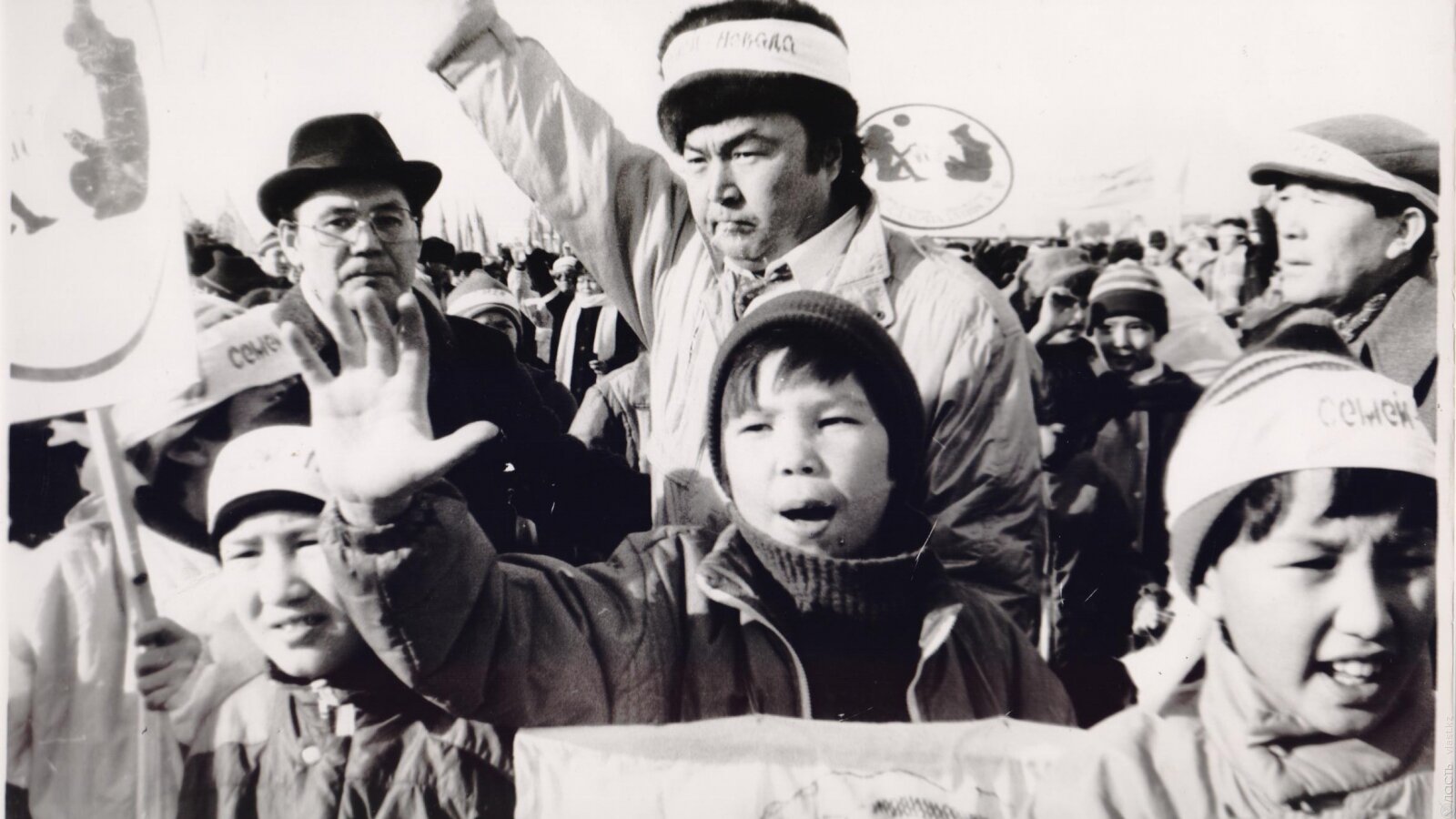
A protest near Semipalatinsk in 1990. Photo from the archives of the Nevada-Semipalatinsk movement.
As grassroots pressure grew on political institutions, what Suleimenov called an important “moment of democracy” was for Krupko a historical milestone.
“Every Kazakhstani truly recognized and demonstrated themselves as a full-fledged creator of the future and master of their land,” Krupko told Vlast.
But the ultimate decision to end testing in Kazakhstan came from above, and after years of protests across the Soviet Union and turmoil in Kazakhstan, the closure of the Semipalatinsk test site was an easy political win for Nazarbayev as a newly-minted leader.
“He also passionately, like them, wanted the economic independence of Kazakhstan and the prohibition of harmful tests,” Nazarbayev’s autobiographical website says of the grassroots movement to close the Semipalatinsk site.
On 20 November 1989, the Supreme Soviet of the USSR adopted a resolution to close the Semipalatinsk Test Site. On 22 May 1990, the Supreme Soviet of the Kazakh SSR also adopted a resolution to close the test site. On 29 August 1991, just months before the collapse of the Soviet Union, the site was finally closed.
According to Kamila Smagulova, a PhD candidate at the University of Leiden focusing on the history of the anti-nuclear movement, the public significance of these later dates and the turning of the Polygon’s closure into one of Nazarbayev’s first major achievements has led the Nevada-Semipalatinsk activists’ crucial impact being downplayed.
“Their contributions are seriously underestimated. Overall, in public narratives, the story seems to be that Nazarbayev was the one who signed this resolution and who closed the Polygon. But before that, it was the people who mobilized,” Smagulova told Vlast.
Victory From Defeat
At the time, the October 19 test felt like another blow against the movement’s efforts.
“Despite months of protests, when ordinary citizens stood shoulder to shoulder demanding an immediate shutdown, the Soviet authorities still went ahead with the October 19 test,” Alisher Khassengaliyev, co-founder of the Steppe Organization for Peace (STOP), a youth initiative for nuclear justice, told Vlast.
But with political winds in the country changing, it soon became clear that the explosion would be the country’s last.
“The power of civil society was so strong that the Soviet government had to listen. That was the day that began Kazakhstan’s nuclear free path for the coming years,” Smagulova added.
“Thanks to popular support, in 1989, the Nevada movement stopped 11 of the 18 explosions planned for that year at the Semipalatinsk test site,” Krupko said.

Olzhas Suleimenov speaking at an international anti-nuclear congress in 1990. Photo from the archives of the Nevada-Semipalatinsk movement.
Lasting Harm
For many, the importance of October 19 takes on greater significance in view of the decades of harm caused by testing at the Polygon, both in the immediate area of Semey and across Kazakhstan more broadly.
According to Khassengaliyev and Smagulova, the secrecy employed by the Soviet government worsened the level of exposure and potential harm that the local communities had to face.
“Behind secrecy and censorship, civilians were exposed to nuclear tests while the land was treated as empty and expendable. This was not an accident of history; it was a deliberate system of violence that left intergenerational harm and long-lived contamination,” Khassengaliyev told Vlast.
“The people living near the test site did not even know what was going on in their own land. They heard the explosions in the morning, but they were never informed, and even later were never given proper compensation,” Smagulova said.
Nowadays, the new generations are somewhat aware of the Polygon’s history, according to Gulzhanat Tanabekova, who is chairperson of a Nevada-Semipalatinsk youth chapter in Almaty.
“Most young Kazakhstanis understand the harm caused by nuclear testing — its devastating impact on public health and the environment. They understand that our land has become the site of horrific experiments, the consequences of which will be felt for millennia,” Tanabekova told Vlast.
But further historical and environmental research is needed, according to Tanabekova, who is also a senior lecturer in the Sustainable Development department of Al-Farabi Kazakh National University.
“Although numerous books and scientific papers have been written about the Semipalatinsk test site, its environmental condition remains insufficiently studied,” Tanabekova said.
A Day to Remember
Activists from multiple generations are now lobbying for October 19 to become a more significant date in Kazakhstan’s calendar, beyond existing anniversaries that focus on the final top-down decision to close the Polygon, rather than the bottom-up movement that inspired it.
As veterans from the Nevada-Semipalatinsk movement gathered for a recent conference in Almaty, top of the agenda was obtaining more recognition for the grassroots movement that set a global precedent by ending nuclear testing in Kazakhstan.
“[October 19] showed that people had realized their voice in making crucial government decisions,” Lyudmila Prus, a longtime-veteran of the Nevada-Semipalatinsk movement told Vlast. “It is part of the history of the formation of our country’s civil society.”
“Since then, Kazakhstan has been remembered as the leader of the anti-nuclear movement worldwide. We must remember that it was the people who closed the test site! It is essential that future generations know and remember this,” Krupko said.
For Khassengaliyev, a further shift of perspective towards the people that were affected by the decades of testing is equally overdue.
“The end of detonations was not the end of suffering or of the struggle for justice. Survivors still carry harm in their bodies; our lands still hold toxins; our families still need truth, recognition and repair,” Khassengaliyev told Vlast.
“The only way forward is partnership between state and civil society, towards a survivor-centred, systematic approach to assistance and remediation,” Khassengaliyev said.
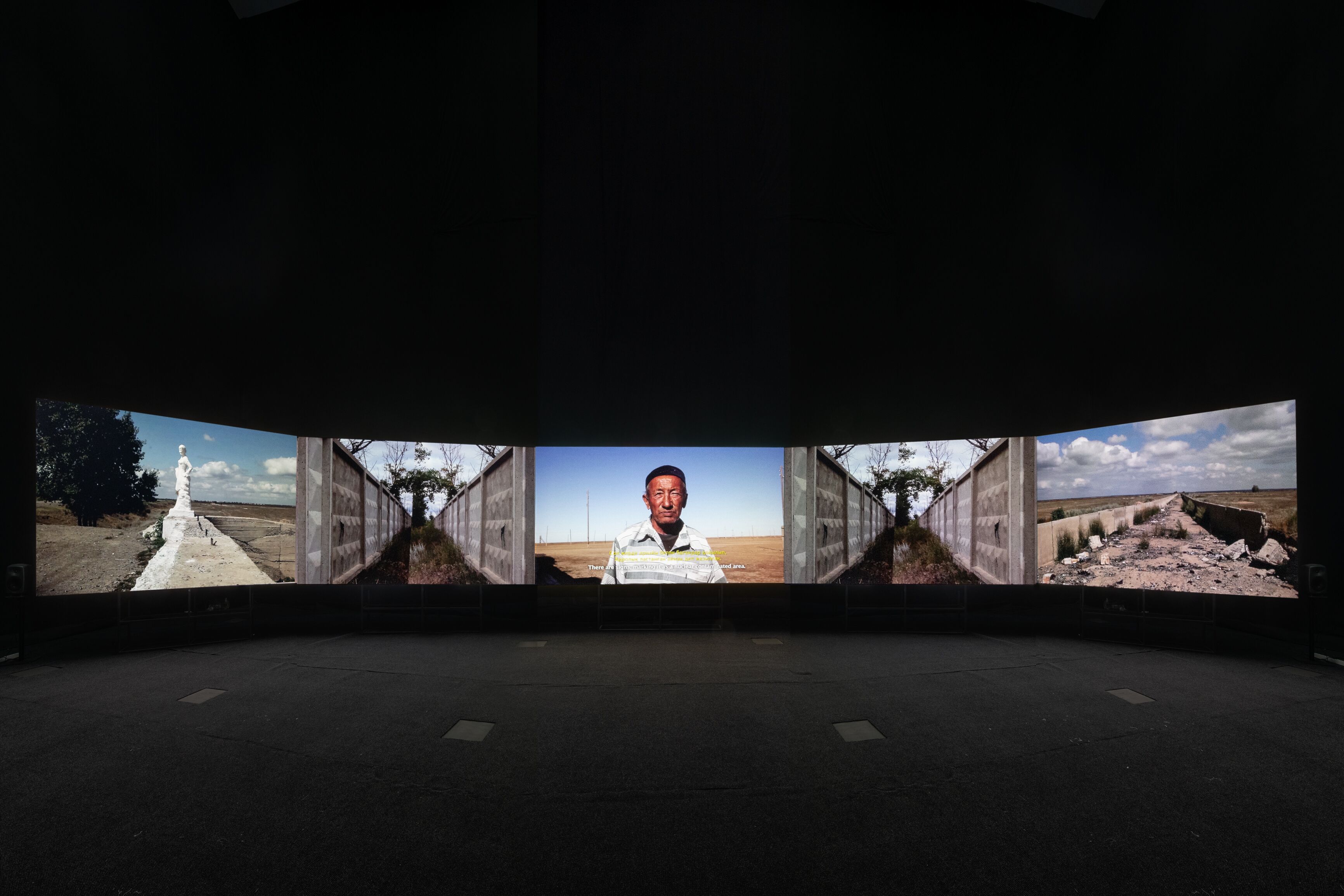
Almagul Menlibayeva, "Kurchatov 22" (2012), installation at the Almaty Museum of Arts. Photo by Alexey Narodizkiy. Used with permission.
Such a change in perspective could ultimately come from the Semipalatinsk Polygon’s newfound prominence in Kazakhstan’s public and cultural discourse.
The newly-opened Almaty Museum of Arts, for example, includes a video installation made by Almagul Menlibayeva which tells testimonies from the secret town of Kurchatov, located at the Polygon’s edge.
For Smagulova, it is poetic that Kazakhstan’s cultural community is currently shining a light on the Polygon, considering the Nevada-Semipalatinsk movement’s original involvement of many artists and cultural figures:
“We are seeing a revival of where the movement came from, with prominent people from Kazakh culture and literature like Olzhas Suleimeinov leading it and fighting for their rights, for their land, for living.”
In 2021, Vlast produced special project with a number of articles and a documentary film about the closure of the Semipalatinsk test site. Read more (in Russian) at polygon.vlast.kz.
Sign up for our English-language newsletter.
Поддержите журналистику, которой доверяют.