Almaty Air Initiative’s CEO Zhuldyz Saulebekova sat down with Vlast to discuss her approach to solving the city’s notorious air pollution problem.
How did you find your way to Almaty Air Initiative?
This is my first non-profit project ever in my life. I spent the last 10 years of my career working in IT companies. But the thing is, air pollution is a problem which has been bothering me for a long time. As a mother of two, I've been considering moving out of the city for three or four years. And then I saw an Instagram post from Arsen Tomsky [founder of ride hailing service inDrive] calling for an initiative to battle air pollution. And I thought, that's interesting. When we met, he said: ‘let's do this in a business way.’
Where does the air pollution in Almaty come from?
That's one of the most debated topics in the Almaty expert community, but there are still three causes which everyone agrees on:
If we look at the official data, they say that 60% comes from transport, 27% comes from the industrial sector, including coal-fired power plants, and 11% comes from solid fuel use in households, that is people heating their homes by burning coal or firewood.

Photo: Vlast.kz
But the accuracy of this data is debated.
I think there is a difference in terms of how we measure things. If you use different scales and approaches, you get different results, right?
So let’s take this analogy. Imagine you’re making spicy ramen. Of course the broth will take up the most space in the bowl, meaning it has the highest volume, but it’s the tiny bits of chilli pepper that sets your mouth on fire. It doesn’t make sense to say that the broth has the most intense flavor just because it takes up the most space. Because although the chili flakes are small, they have the strongest physical effect on you. This is similar for toxic particles in the air. We don't see them, but they could kill people.

Photo by Paolo Sorbello.
And it's the same with Almaty’s air pollution problem. Outdated air pollution measurements add up the total volume of pollutants. Let's say that we have 650,000 cars, and they contribute a certain volume of carbon monoxide, the main pollutant coming from cars. And since carbon monoxide takes up a lot of physical space, it's considered to account for 60% of air pollutants in the city. This is the model that the city government currently uses to measure air pollution. According to their outdated methodology, it's correct. But is the methodology correct?
If, like in our new monitoring dashboard, we focus on highly-toxic PM2.5 particles, the picture is different. Because PM2.5 particles are tiny. You cannot compare them with gases, because gases have a higher volume. Through this outdated methodology they are basically comparing apples and oranges.
Is there anything that makes Almaty’s air pollution issue unique?
Almaty is located in a mountain basin, which means that pollutants get trapped in the city. Normally it’s colder at higher altitudes, but because of our mountains, it's different. In the wintertime we have this warmth coming from the city combined with the cold wind, alongside other peculiar atmospheric processes that create a layer of warm air which traps the pollution in between.
We love Almaty because of the mountains. It's a blessing and at the same time a curse. We cannot change our geography, but we can change our pollutants and source of pollution.
Absolutely.
And in this regard Almaty is actually not a unique city. Mexico City and Los Angeles, which are located in mountain basins, have the same problem.
But let's take into account another factor we don't talk much about: the population of Almaty has increased by 500,000 in the past 10 years. That’s like all of Karaganda [Kazakhstan’s fifth-largest city] coming to Almaty. And of course it creates pressure on the infrastructure because everyone needs to use public transport or buy cars and houses. This has made Almaty really crowded.
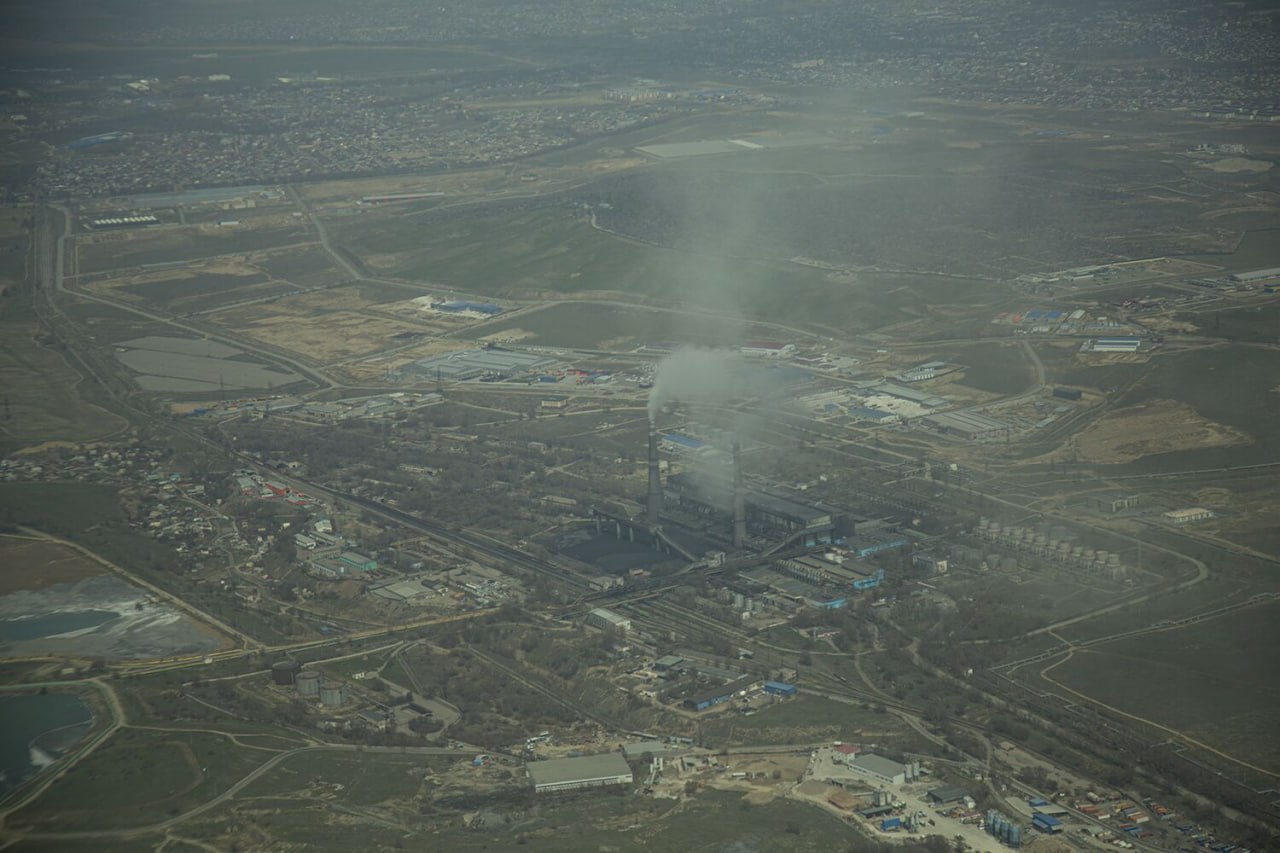
Photo by Zhanara Karimova.
How can the city combat this issue?
We need to decentralize. Because those living in Almaty region travel to Almaty, but if they could have their own infrastructure nearby, like schools and medical centers, they wouldn’t have to travel from one part of the city to the other as often.
How does Almaty Air Initiative fit into the city’s battle against air pollution?
We push for both regulation and awareness. We set up meetings with government officials, stakeholders, and businesses to explain to them which regulations we need. These changes are vital so that entities like factories and enterprises can take accountability.
And changing awareness is not just making people understand that pollution is dangerous for their health. It’s also about encouraging them to push for and accept these new reforms. For example, I recently met with the Almaty mayor and discussed the possibility of establishing a low emission zone, which would be a quite unpopular decision. That means that if you enter the city and your car is highly pollutive, you have to pay a fee.
And imagine you have these people who have very low awareness and don't care about air pollution. They have other things to care about. Of course their reaction will be like, what? I'm not going to pay.
So without campaigning, without explaining to people why this is needed, the measure won’t work. For this reason we agreed that we could create a strategy where we would approach audiences with a clear message for why this is all happening. Without this, it's not going to work.
So how does Almaty’s air pollution problem compare to other Central Asian cities?
If we compare it to other Central Asian cities, I would say it's pretty different from [Kyrgyzstan’s capital] Bishkek. There, we still have the same top three or four sources of pollution and the number one problem is residential heating. Because there, even new private houses have separate boiler rooms and burn coal for heating. They also have a very similar geographical location to Almaty, and they have many old cars, another issue we have in common

Photo from air.org.kz.
Are you considering working with other Central Asian cities in the future?
Yeah, absolutely. Why not? I think we could collaborate on many levels.
I think Almaty can become a successful example of combating air pollution in Central Asia. If you could easily do this in Almaty, maybe that would turn into best practices for other Central Asian cities like Bishkek or Tashkent, in Uzbekistan. Other Central Asian countries can say ‘look, they did this, why don’t we do this?’. After all, they can refer to an example from Kazakhstan, with a similar culture and economy, rather than Western countries.
How are you feeling about the future of your work?
I think maybe I'm too optimistic. People say to me: ‘Oh, you are not burned out yet, that’s why you’re so optimistic. Let's talk next year when you'll be burned out.’ But I think there needs to be an organization that is optimistic.
I remember my childhood in the 1990s. The Soviet Union collapsed, and it was a tough time for everyone. No one was thinking about ecology or the environment. Everything was about survival.
But now I think our country and our society is ready to battle air pollution. Why shouldn’t we believe that we can do it? Why shouldn’t we be optimistic?
I think it takes courage and political will and optimism. Because if people just believe that nothing will work, nothing will change. And if it doesn’t work out, at least we tried.
Поддержите журналистику, которой доверяют.