For the past ten years, Akylbek Muratbai has worked to protect the labor and civil rights of Karakalpaks in Kazakhstan. After the repression of urban protests in Karakalpakstan, an autonomous republic in Uzbekistan, in July 2022, he was among the activists targeted by the Uzbek authorities.
Muratbai was in Kazakhstan at the time and, after a request from Uzbek authorities, he was arrested and spent a year in a pretrial detention center in Almaty. At that time, he applied for political asylum in Kazakhstan, because he potentially faced political persecution and torture in Uzbekistan.
In September of this year, Kazakhstan's Supreme Court denied asylum for Muratbai. The human rights activist appealed to Western countries for help, but has yet to find any support. Now he finds himself in limbo, facing deportation at any moment, which, he says, is “basically like dying.”
In a half-empty coffee shop in an increasingly colder Almaty, Muratbai sends some voice notes in response to a few Telegram messages. He stops and laughs.
“People are so scared that they ask me to confirm my identity with my own voice,” he said before we started the interview.

The latest news says that your asylum application was denied once again, this time by the cassation court. What was their reasoning?
I initially didn’t want to go: it was too expensive for me to attend the hearing in Astana, plus it was clear that it would be denied. After representatives of Western embassies said they would also come and support me, I decided to attend the trial.
In my 20-minute appeal, I cited specific examples based on the testimony of the lawyer of Dauletmurat Tajimuratov [a political prisoner in Uzbekistan, sentenced to 16 years after the July 2022 protests in Karakalpakstan – V.]. I cited statements from international organizations and the Office of the UN High Commissioner for Human Rights about torture, unfair trials, and deaths in Uzbek prisons. I cited the names of those who died while incarcerated in prison: Polat Shamshetov and Mustafa Tursunbaev. I described the torture of Tajimuratov and Zhumasapar Dadebaev.
The judges didn’t even ask any follow-up questions. They went away for 20 minutes and said they decided to uphold the previous court’s decision to deny asylum. They said that they saw no risk of arrest, torture, unfair trial, and so on.


This was, after all, the outcome you expected.
It was. But this could continue endlessly, so why don’t we do this: even if I don’t receive refugee status, they simply could reconfirm my asylum-seeker status every year.
What is your legal status now, after the latest denial?
Now, I have no legal status. On the day of the trial, my asylum-seeker status was revoked. I’m no longer under protection. I could be extradited at any time.
How did you start your activism?
I’ve been working to protect the rights of people in the Karakalpak diaspora since 2013. I helped people obtain their wages and documents while being exploited in Kazakhstan. I even helped with logistics to transport the bodies of Karakalpaks who died here back to Karakalpakstan. I acted as an intermediary between the Uzbek Consulate and the people. I helped people without compensation. And for this, the Uzbek authorities have been persecuting me since 2014. That’s when Uzbek security services questioned me and my relatives for the first time. I haven’t returned home since then because they’re constantly asking about me there.

Photo from Muratbai's archive.
What are your plans?
I’m waiting. Before my arrest, I met with representatives of the US Consulate five times. And they all initially said the United States wouldn’t help or provide any asylum. The most they could do was ask their European partners to help me.
About a month before my arrest, with the support of the Central Asian office of the United Nations High Commissioner for Refugees (UNHCR) and the US Embassy, they finally decided to grant asylum. I served as the contact person and provided brief case studies and justifications for those who needed to leave and who could potentially be arrested.
On 15 February 2024 of last year, around six p.m., I sent the documentation to the US Embassy, and four hours later I was arrested. While I was in the pretrial detention center, I was promised that US government representatives would pick me up as soon as I was released, that I was on a list. While in the pretrial detention center, I underwent interviews with US officials.
But two weeks before my release in February 2025, my wife received a call from the Embassy informing her that [US President Donald] Trump had frozen my case. The Embassy representatives told her it was better to look for help with another country.
We’re looking for other Western countries that might accept me. After the US, France also turned me down. They told me that Uzbek President Shavkat Mirziyoyev was going to visit France and sign agreements on uranium deposits, they said that before such major agreements, they couldn’t raise the Karakalpak issue, because it would damage relations with Uzbekistan and possibly disrupt the contracts.
They told me they wouldn’t issue an official refusal because if it were to leak to the media, it would attract unnecessary attention. Especially since French President Emmanuel Macron is trying to become the leader of the democratic world, while Trump has chosen a different path. They simply said it wasn’t an outright refusal, but if I submitted an application, they would drag out the process.
In other words, money matters more than human rights.

Were there success stories among other activists? What can be expected in Central Asia?
I wrote thousands of letters to parliamentarians and government representatives in the West. I did receive help and support from some of them – the US diplomatic mission in Kazakhstan granted asylum to four Karakalpak activist families, a true miracle! – and, most importantly, from local and international human rights activists. But Western governments are unlikely to grant asylum because they believe that “there is no evident risk of unfair trial and torture.” And, the Germans, for example, did not see this risk.
This is interesting because in my time at the pretrial detention center I met people persecuted by Russia. I know their cases.
And most of them were granted asylum by Germany and France, even though they weren’t involved in civic activism. It was the right choice to protect them, but Western countries do not see the same risks as in my case.
And why am I telling you this? All these representatives from European embassies are telling me, “Oh, how could that be? How could Kazakhstan refuse you?” Well, Germany also refused, with the same reasoning.
If countries considered flagships of the democratic world behave this way, others will follow their policies. This is an indicator of how much the overall situation has worsened.
In short, this is the position of democratic European countries. No one cares what’s happening in Central Asia. In Tajikistan, six civil society activists have died in prison since the beginning of the year. There’s been no adequate response to these deaths from democratic countries. It’s simply shocking.
People in Central Asia are being tortured. The pressure on the media is colossal. It’s all escalating. In a few years, the screws will be tightened so much that ordinary people will feel the effects.
My Uzbek passport expired on 9 August 2025. With it, my residence permit has also expired. I’m undocumented. Before August, my only option was to travel to another country as a tourist or attend a human rights conference and apply for asylum there, but now I can’t do that anymore.
The Uzbek authorities won’t give me a new passport.


But you never wanted to leave Central Asia.
Exactly. I planned to live in Tashkent. I studied there for four years. The country suited me. Then I came to Kazakhstan on a business trip, met my first wife, and settled here.
Yes, I left Tashkent, where I was very happy, but I don’t want to leave Central Asia.
After the first arrests, I was also offered the chance to leave. They said the risk of them coming for me was increasing. I had support within the diaspora, they offered to pay for visa procedures, tickets, and accommodation for the first few months. I refused. Then, international human rights activists suggested I should leave and seek asylum.
Why should I leave? I’m not doing anything illegal. If I leave, the authorities will use it against me and the diaspora, claiming I fled “because of my criminal activity.”
Are there other civil activists who are persecuted by Uzbekistan and remain in Kazakhstan?
Yes, and I’m worried about Rassul Zhumaniyazov. He’s also a Karakalpak activist, arrested in Astana some time after me. He’ll face the same trial as me within a month.
I’m getting no acknowledgement despite being active on social media, communicating with journalists and human rights activists. This man will get zero attention.
Besides us, there are other groups of people.
Some fled and are stuck in the asylum seeking bureaucracy abroad. Some others are ordinary people, not activists, who have been pressured in Uzbekistan because of their social media comments. And others are just worried: they don’t know if they can go and visit their relatives in Karakalpakstan. There are currently many ethnic Karakalpaks in Kazakhstan who haven’t returned to their homeland since 2022.
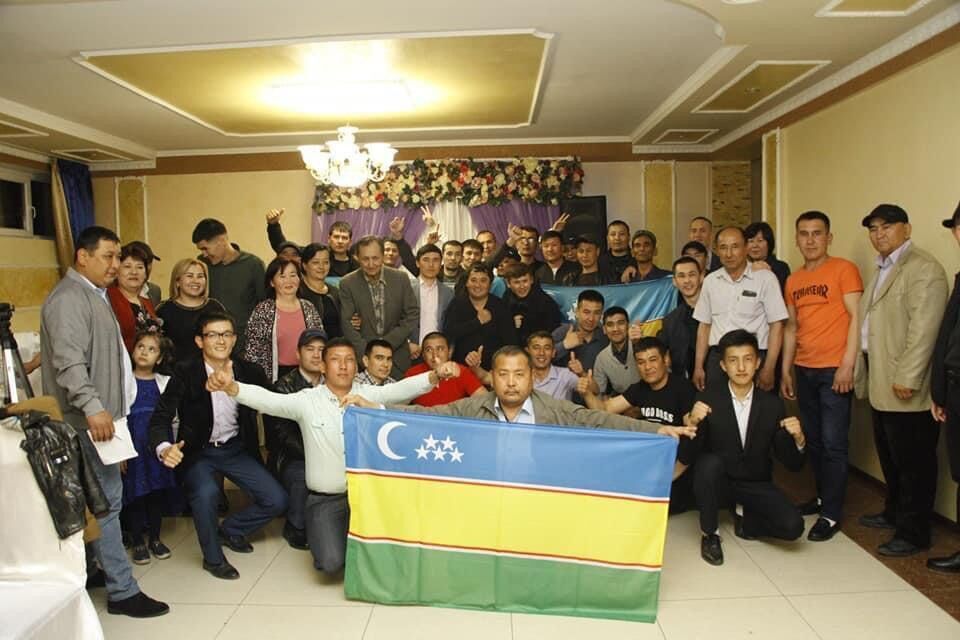
Photo from Muratbai's archive.
Inside Karakalpakstan, it seems that civil society has been quashed since the July 2022 protests.
Absolutely. Human rights activist Azimbay Ataniyazov, an ethnic Uzbek, became the face of civil society in Karakalpakstan. The Uzbek authorities promoted him because of his pro-Uzbek stance. And even he said in an interview that the blogging scene in Karakalpakstan is dead. Not just human rights or civil society, but even blogging!
Mirziyoyev appointed his daughter, Saida, who’s being touted as his potential successor, to oversee Karakalpakstan.
Yes, Saida is clearly being groomed as his successor. But I don’t think Uzbek society will welcome her. The country is very diverse. From the Fergana Valley to Samarkand, to Karakalpakstan. She can become president for a few years, but the clans won’t accept her, partly because she’s not a man. Unfortunately, the situation with gender equality in Uzbekistan remains very poor, and this will ultimately impact major domestic political decisions.
Officially, the Uzbek authorities say the Karakalpaks govern themselves. We have a parliament, an anthem, and a Karakalpak leader, Amanbai Orynbayev. So why did they appoint Mirziyoyeva? Will she have authority over him?
Farhod Ermanov, the chairman of the Karakalpak government, was Mirziyoyev’s classmate and his protegé. Gradually, ethnic Uzbeks from other regions are being appointed to leadership positions at various levels in Karakalpakstan.
This situation is unnerving, although the public remains silent. Because the blogosphere and civil society have been purged, there are no mechanisms to let off steam. This will accumulate.

Uzbekistan's President Shavkhat Mirziyoyev, during a speech in Nukus, Karakalpakstan. Photo: president.uz.
What could this lead to?
Two parallel processes are taking place here. After the protests, national consciousness has greatly strengthened, but on the other hand, the situation is escalating due to pressure. Radicalization is underway.
I have always been a supporter of the peaceful path and so has Dauletmurat Tazhimuratov [considered one of the leaders of the July 2022 protests - V]. In fact, some people believe he made a mistake when he asked people to disperse. They say he should have stood up to Mirziyoyev.
Some tell me: “Don’t be naive, they won’t listen to you. Peaceful means yield no results. People are still dying.” This is how the radicals gain momentum.
What is the government doing for Karakalpaks that are also Kazakhstani citizens?
Nietbay Urazbayev was a citizen of Kazakhstan. But after the protests, in 2023, Uzbekistan’s Prosecutor’s Office was able to strip Urazbayev of his citizenship. He died in 2024.
Since 2013, Nauryzbay Menlibayev has been a citizen of Kazakhstan. He went to Karakalpakstan and was tortured in a basement. That is, Uzbek security services tortured a citizen of Kazakhstan. And no one moved a finger until his sister filed an official complaint with the Embassy.
In court, I said: is this how you value your citizens?

The July 2022 protests in Nukus. Photo: Makan.uz.
After going through all this, how do you feel?
It’s been a tough two years. The time spent in the detention center itself was harsh, but the events that followed are even more difficult. My family is tired, you see. Constant risks, arrests, and visits from the security services, even before the protests.
My parents are also categorically against my activities. And I understand them.
Going back to Uzbekistan, for me, is practically comparable to death. There, I’ll likely be imprisoned for life.
My sisters and wife are understanding and supportive, and I'm very grateful to them for that.
The Karakalpak diaspora has always provided tremendous support, and that includes not only the Kazakhstani community but also Karakalpaks living in other countries. I could go and settle somewhere, but who knows whether I’ll leave. Will I be able to come back to Kazakhstan to visit my parents?
Yes, I could have left in August. I could have started the asylum process somewhere else. But that’s very difficult because of the anti-immigrant sentiment in Europe.
A human rights activist told me, “Akyl, you shouldn’t go. I can see you’re already at rock bottom. If you have to go through another couple of years of trials you’ll simply burn out.”
But I also feel backed into a corner. The worse it gets, the more motivated I am. There’s nothing left to lose.
People planning to engage in human rights advocacy at this point in history need to understand that they are alone. There is no support from Western countries. The likelihood of receiving assistance is close to zero. If possible, it’s better to wait it out.
But I’ve always said that even if I’m extradited and arrested, several more people will emerge to take my place. Everything the Uzbek regime is doing now only radicalizes and exacerbates the situation.
This is an edited translation, shortened and slightly amended for clarity.
Sign up for our English-language newsletter.
Поддержите журналистику, которой доверяют.