Kazakhstan’s President Kassym-Jomart Tokayev publicly criticized change policies and said his country would still focus on coal as the main fuel for electricity generation—a move experts call a major setback for energy transition hopes.
Speaking at a forum of the National Council for Science and Technology on September 26, just days after his visit to New York, Tokayev used sharp words against the global focus on climate change.
“I participated in the global climate summits in Dubai and Baku [and] frankly, everything that is happening looks like a large-scale fraud,” Tokayev said.
Tokayev said he agreed with the statement by US President Donald Trump that climate change is “the greatest con job ever perpetrated on the world.”
This statement reflects a recent policy shift, by which Tokayev seems to have completely abandoned any rhetoric on the importance of a green transition for Kazakhstan.

Tokayev (center) at the National Council for Science and Technology. Photo: akorda.kz.
A Reverse Con Job
Tokayev’s language used to be quite different. Speaking in Dubai at the 2023 United Nations Climate Change Conference or Conference of the Parties, better known as COP28, he emphasized the need for cooperation to counteract the climate crisis.
“The climate emergency is a global crisis that requires a global response. We share joint responsibility for preserving our planet and ensuring a sustainable future for all. Kazakhstan firmly believes that only through collective action and cooperation can we solve the climate crisis,” he concluded.
The following year, at Baku’s COP29, Tokayev “reaffirmed Kazakhstan’s commitment to the global climate agenda and emphasized the importance of international cooperation in combating climate change,” according to the official press release.
Since 2023, Kazakhstan has pledged to achieve carbon neutrality by 2060 and Tokayev seemed to be worried about the consequences of climate change for Kazakhstan and the wider Central Asian region.
“Despite the fact that Central Asia accounts for only 1% of global emissions, the region faces numerous climate risks [...] Climate change is already having a serious impact on the global water cycle. [...] This year, Kazakhstan faced unprecedented floods. [...] Today, the Caspian Sea is under threat. Saving the world's largest lake is a shared challenge that requires long-term international cooperation,” these were just some of Tokayev’s climate-focused statements in Azerbaijan’s capital in November 2024.
The policy shift became visible earlier in September, during the Address to the Nation. In his long speech, Tokayev did not mention climate change or decarbonization, and only cited renewable energy sources in passing. Instead, he chose to focus on coal.
“Given Kazakhstan’s vast reserves of high-quality coal, we should also pay special attention to developing coal-based energy using advanced technologies that guarantee its cleanliness,” Tokayev said.
In his latest speech, Tokayev went all out for coal and against renewables.
“Kazakhstan produces 113 million tons of coal annually, making it a top 10 producer in the world. This is our asset, something that we must manage wisely. The US President rightly said, ‘I don't like wind, I like coal’,” Tokayev said.
After installing wind farms and solar plants with hundreds of MW of capacity, the statements by Tokayev sound like a U-turn.
“Indeed, wind turbines, like the energy they produce, are extremely expensive. Moreover, turbines can cause serious damage to the environment,” Tokayev added. “And [coal] is cheaper to use than wind, solar, or gas.”
In 2024, Kazakhstan produced 66% of its electricity with coal, 10 times more than the electricity produced by renewable energy sources. Although growing, the share of renewables in the energy mix remains marginal.
Kazakhstan’s leadership is not new to policy reversals on renewable energy or decarbonization policies. In 2014, just as the country was preparing for the green energy-focused EXPO-2017 in Astana, then-President Nursultan Nazarbayev poured cold water on any plans for a greener Kazakhstan.
“I personally do not believe in alternative energy sources, such as wind and solar,” Nazarbayev said. “Oil and gas is our main horse, and we should not be afraid that these are fossil fuels.”
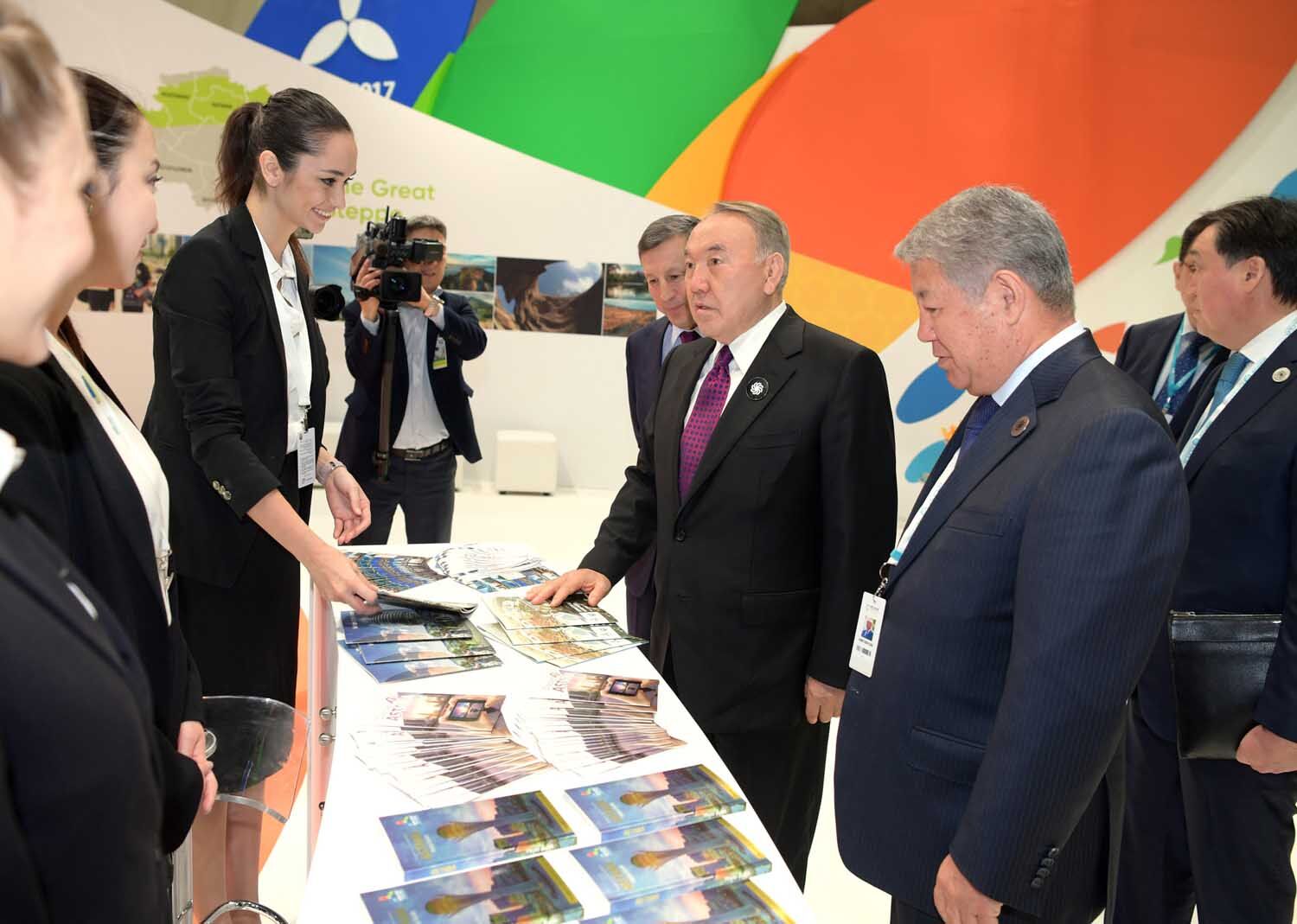
Nazarbayev at the EXPO-2017 pavilion. Photo: akorda.kz.
Ash and More Ashes
Kazakhstan produces around two-thirds of its electricity through coal-fired power plants, most of which are aging or beyond a sustainable lifespan. At the end of 2023, Kazakhstan’s state-owned electricity company agreed with its Russian counterpart to build three new coal-fired power stations in the east and north of the country.
Observers considered this a major setback in the country’s drive towards decarbonization. Daulet Assanov, director at the Center for Environmental Safety in Oskemen, said that the latest speech calling climate change a “fraud” would give the green light to the coal industry to continue their business unabated, at the expense of a greener energy mix.
“Despite being only a small part of the industry, the three thermal power plants will impose additional costs to the billions already earmarked for the modernization of existing coal-fired power plants,” Assanov told Vlast.
Ivan Radelyuk, associate professor in chemistry at Toraighyrov University in Pavlodar and an advocate for decarbonization, added that the abysmal state of thermal power plants in the country could not sustain the investment needed for the ‘advanced technologies’ that, in Tokayev’s words, would make coal use cleaner.
“Given our aging thermal power plants, and the constant ‘patching of holes’ and boiler repairs, I cannot see any scenario in which energy producers would voluntarily and effectively implement the above-mentioned technologies,” Radelyuk told Vlast.
According to Maria Stepanova, an energy transition expert and director at EnergiaVita, one must account for the negative consequences of coal use in terms of energy efficiency, as well as carbon emissions.
“If you honestly factor these negative impacts into the price, a kilowatt-hour of coal will not be that cheap at all,” Stepanova told Vlast.
What has become cheaper, according to industry observers, is the cost of installing renewable energy capacity. In this regard, Uzbekistan has accelerated with bringing online solar farms that are making up for the country’s growing electricity demands. Kazakhstan should follow suit, according to renewable energy advocates.
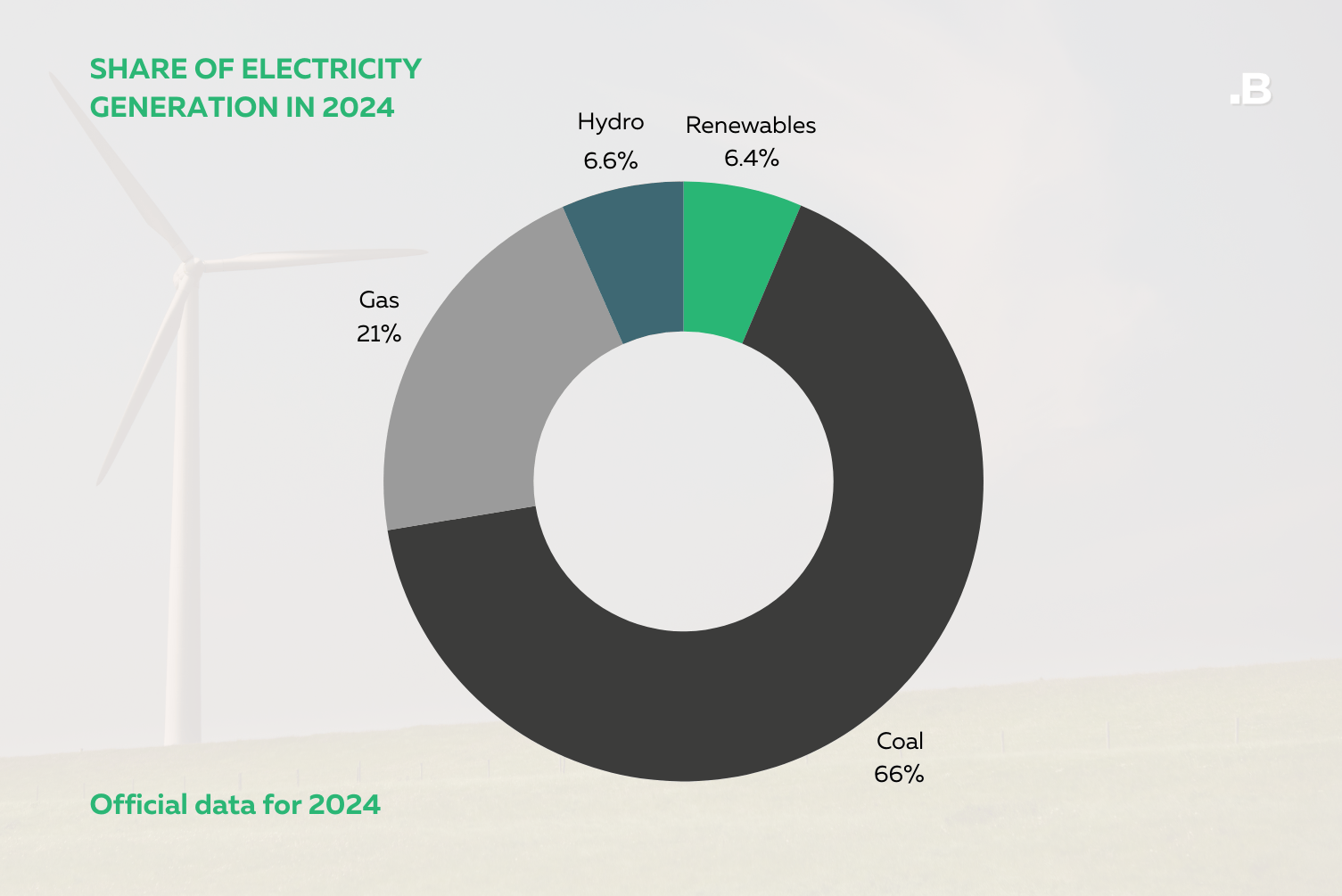
Kazakhstan's energy mix. Illustration: vlast.kz.
The reason Kazakhstan is still focused on coal could have to do with a strong industrial influence from major players in the sector.
“In my opinion, Kazakhstan has a very powerful coal lobby that is hindering the development of the energy sector in line with modern trends,” Assanov added.
An investigation by Vlast showed just how powerful the coal lobby has been in recent years in its efforts against the government’s decarbonization plans.
One of the coal lobby’s most successful policies has been to convince the public that Kazakhstan’s coal is of high quality.
“The president said we have reserves of ‘high-quality coal,’ – something that raised eyebrows among experts. This coal, which powers most of Kazakhstan’s thermal power plants, has very poor characteristics: its ash content is 42%. That’s a lot,” Radelyuk said. “Coal is the dirtiest energy source.”
According to Radelyuk, this results in low energy efficiency and massive emissions of pollutants into the atmosphere.
Zhuldyz Saulebekova, the director of Almaty Air Initiative, an NGO focused on reducing air pollution in Kazakhstan’s largest city, argued that coal use is among the largest contributors to PM 2.5 emissions.
“If coal remains part of the energy mix, it is crucial to use high-calorific, low-ash fuel. Yet, retrofitting decades-old coal plants is viable, but complex — many lack the space and design needed for modern filtration systems,” Saulebekova told Vlast.
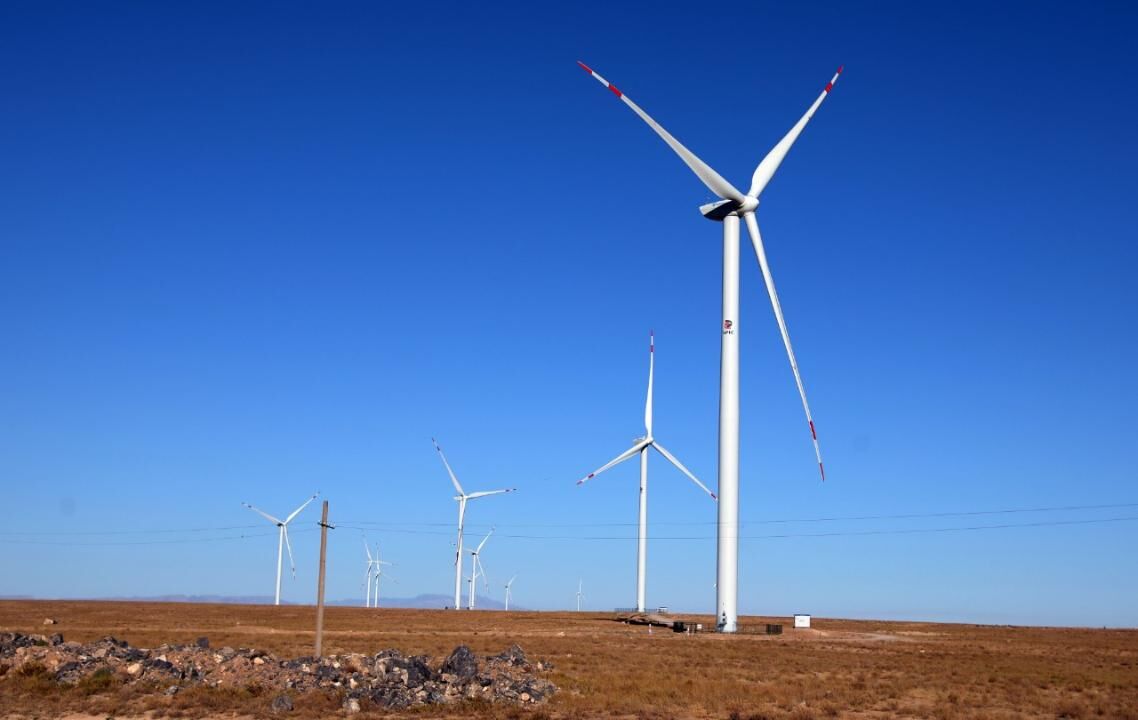
A 100MW wind farm in Zhanatas. Photo: Zhambyl Regional Government.
Exports in Danger
The policy reversal could also shift investment plans, according to Assanov.
“Now the ministry of energy can safely shift its focus from renewable energy to coal and invite investors [in this sector]. We shouldn't expect large-scale development [of renewable energy sources] with huge public investments; the focus will entirely be on coal,” Assanov said.
More emphasis on coal is poised to have a negative impact for Kazakhstan, in light of the upcoming implementation of the European Union’s Carbon Border Adjustment Mechanism, a policy that would set up a system of rewards and punishments for cross-border trade according to the carbon intensity of imported goods.
According to International Monetary Fund estimates, Kazakhstan is slated to lose around €250 million per year on missed exports, if its energy mix continues to use so much coal. In particular, research by the Astana International Financial Center found that aluminum exports alone would be €40 million more expensive in 2026.
Official figures say that 39% of Kazakhstan’s exports go to EU countries.
Should the CBAM policy go beyond the current list of products–aluminum, iron and steel, cement, and fertilizers–and include petroleum products and chemicals, yearly losses could reach €1.4 billion.
“Kazakhstan falls under the scope of the CBAM, and the government is supposed to adopt measures towards meeting this standard,” Radelyuk said.
During a 2024 seminar on CBAM, Ainur Amirbekova, director of international integration at QazTrade, under the ministry of trade, said that public investment is needed to drive the decarbonization of industrial production.
“The higher the hydrocarbon content of Kazakhstan’s exports, the higher the taxes and fees in importing countries will be. Therefore, it is necessary to develop an action plan to modernize production processes and allocate funds for their implementation, including from the budget," Amirbekova said.
Against the Trend
In terms of global trends, Tokayev’s decision stands in stark contrast with China’s President Xi Jinping, who indirectly criticized Trump’s statements.
“Green and low-carbon transformation is the trend of our times. Despite some countries going against the trend, the international community should stay on the right track, maintain unwavering confidence, unwavering action, and undiminished efforts,” Xi said.
Being the world’s largest CO2 emitter, China promised to work hard to achieve carbon neutrality by 2060.
Indra Overland, research professor and head at NUPI’s Center for Energy Research, looks at Tokayev’s U-turn as an example of weak energy transition policies.
“Tokayev’s statement bodes very ill for the energy transition in Kazakhstan. It also provides a powerful example of how superficial energy policy choices are in many countries such as Kazakhstan and the importance of international influence. It also shows that the effect of Trump’s climate denial may reach far beyond the US and could be catastrophic for the global climate effort," Overland told Vlast.
According to Radelyuk, “political trends in several countries are shifting toward ‘everyone for themself’ on issues related to the climate crisis. But the fact is, sooner or later, it will affect all of us.”
Saulebekova agrees: “Kazakhstan needs a balanced energy strategy – one that ensures reliable power while keeping air quality and public health at the center.”
Tokayev’s policy shift is also a statement of support for nuclear energy. Earlier in 2025, the head of the new Atomic Energy Agency Almasadam Satkaliyev said that “the development of nuclear energy is an integral part of the plan to reduce the carbon footprint.”
With plans to build more than just one nuclear power plant, Kazakhstan could see a nuclear boom in a decade or so. But for the time being, the status quo is very much carbon intensive.
Yet, there is room for hope, should Kazakhstan truly choose to exploit its renewable energy potential.
“The country has enormous wind and solar generation potential. There are investors, there is demand, many projects are paying off handsomely. Energy transition is not someone's fantasy, but an inescapable global process,” Stepanova said.
Поддержите журналистику, которой доверяют.